

Walking a Thousand Miles
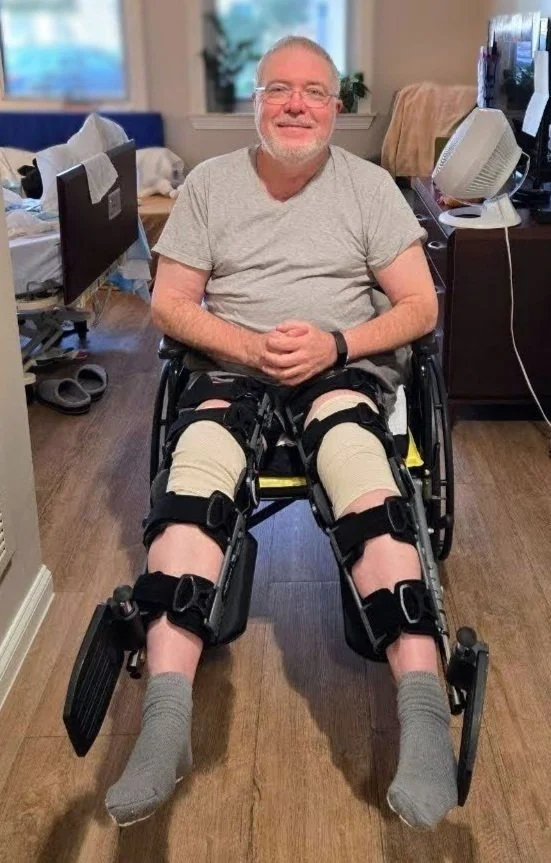
I didn't have the use of my legs when I was in the hospital this past year, so I wound up watching lots of videos online of people walking in the English countryside, hiking in the Swiss alps, that sort of thing. Watching other people walk made me happy and helped me fantasize about walking myself. I wrote in my journal "Tonight I walked a thousand miles in my dreams," hoping that would help me walk in real life.
I didn't have the use of my legs when I was in the hospital this past year, so I wound up watching lots of online videos of people walking. They cavorted in the Cotswold countryside, sashayed along the Swiss alps, dub-stepped in Dublin.
Watching other people walk made me happy and helped me fantasize about walking myself one day. I wrote in my journal: "Tonight I walked a thousand miles in my dreams," hoping that image would help me walk in real life.
This song comes from those journal entries.
Feet on the ground, the sky stretched wide, a compass turning deep inside
The road is long, but I'm alive Each step I take, I learn to thrive
Walking a thousand miles tonight Inside my dreams, I'm taking flight
With every breath, the stars align This journey's mine, this path divine
With forged limbs and healing skin I rose through fire to stand again
Each fall became a higher climb Each fracture marked by sacred time
Walking a thousand miles tonight Inside my dreams, I'm taking flight
With every breath, the stars align This journey's mine, this path divine
Inside the silence, I heard my name, not who I was, but who I became
Threaded through time, the wounded song. I've been the ache, and now the strong.
Walking a thousand miles through flame, unbound, unbroken, shedding shame The stars ignite beneath my skin. I walk restored, I walk within.
© 2025 Billy Lee Myers Jr
Dreaming of Walking

Depression
Depression is a common and treatable condition, and it’s important to know that you're not alone in this struggle. Scores of people are feeling much the same feeling you are right in this moment. Your feelings are valid, and it's okay to not be okay right now. Remember that you are strong and capable, even if you don't feel like it at the moment.

Depression can be improved, honest!
Depression is a common and treatable condition, and it’s important to know that you're not alone in this struggle. Scores of people are feeling much the same feeling you are right in this moment. Your feelings are valid, and it's okay to not be okay right now. Remember that you are strong and capable, even if you don't feel like it at the moment.
You have all the qualities and abilities to get through this challenging time. You've shown resilience by seeking help, which is a significant step towards recovery. It's important to focus on small, manageable goals and take things one day at a time.
You matter, and your life has value. Depression may make you feel otherwise, but be assured you are worthy of love and belonging. Your presence is important to those around you, even if it's hard to see that right now.
Recovery is a process, and it's okay to have ups and downs along the way. It’s important to notice both the difficult moments and the victories, no matter how small they may seem. You have the strength within you to overcome this. You are on the path to rediscover that strength, one step at a time.
Here are some self-regulating strategies to do just that:
1. Grounding Techniques (For Overwhelming Moments)
5-4-3-2-1 Method: Identify 5 things you see, 4 things you touch, 3 things you hear, 2 things you smell, and 1 thing you taste.
Temperature Change: Hold ice cubes, splash cold water on your face, or take a warm bath to shift focus.
Deep Breathing: Try box breathing (inhale 4 seconds, hold, exhale 4, hold, repeat 10 times) to calm your nervous system.
2. Emotional Regulation (For Processing Feelings)
Journaling: Write down your thoughts freely, or try structured prompts like, *"Today, I felt… because…"
Name the Emotion: Instead of saying, "I feel bad," be specific— "I feel lonely," or "I feel lost." Naming emotions reduces their intensity.
Talk to Someone: Share your feelings with a friend, therapist, or support group.
3. Mindfulness & Meditation (For Mental Clarity)
Body Scan Meditation: Close your eyes and mentally scan from head to toe, noticing sensations without judgment.
Loving-Kindness Meditation: Silently send good wishes to yourself and others: *"May I be at peace. May I be safe. May I heal."
Mindful Walking: Walk slowly, focusing on each step, the feeling of the ground, and your breath. This is very helpful if it’s hard to sit still for seated meditation.
4. Physical Self-Regulation (For Energy & Stability)
Gentle Exercise: Yoga, stretching, or a short walk can release endorphins.
Progressive Muscle Relaxation (PMR): Tense and relax different muscle groups to release tension. Also helpful for dropping off to sleep.
Hugging Yourself: Cross your arms and squeeze gently—it can activate calming brain chemicals.
5. Creating Small Routines (For Structure & Comfort)
Morning & Night Rituals: Even small habits like making tea, reading a comforting book, or lighting a candle can bring stability.
Set a "Next Step": Instead of overwhelming to-do lists, ask, *"What is the next small thing I can do?"*
💙

ADHD Strategies
The first thing to know: you are not broken. Your brain just works differently, and that’s okay. Some of the very qualities that make life challenging—your creativity, energy, and unique way of seeing the world—are also your greatest strengths. You don’t have to fit into a mold that wasn’t made for you. Instead, let’s find ways to make life work for you.

Sometimes, the world conspires to distract us.
The first thing to know: you are not broken. Your brain just works differently, and that’s okay. Some of the very qualities that make life challenging. Your creativity, energy, and unique way of seeing the world, are also your greatest strengths. You don’t have to fit into a mold that wasn’t made for you. Instead, let’s find ways to make life work for you.
It’s okay if some days feel harder than others. Progress isn’t about perfection; it’s about small steps forward. You are learning, growing, and finding strategies that help you thrive. Be kind to yourself, and remember, you’re not alone in this. You have strengths, and you are capable. You always, always deserve respect.
1. Structuring Daily Life
Use a Planner or Digital Tools: Writing down tasks and setting reminders can help with forgetfulness. Apps like Todoist or Google Calendar can be useful.
Break Tasks into Steps: Large tasks can feel overwhelming. Breaking them into small, manageable steps makes them more approachable.
Create Routines: A consistent morning, work, and bedtime routine can improve focus and reduce decision fatigue.
2. Managing Attention & Focus
The Pomodoro Technique: Working in 25-minute intervals with 5-minute breaks helps maintain attention.
Noise Management: White noise, instrumental music, or noise-canceling headphones can reduce distractions.
Change Environments: A new setting, such as a café or a different room, can help sustain focus.
3. Regulating Emotions
Mindfulness & Meditation: Simple breathing exercises or guided meditation can improve impulse control and emotional regulation.
Name the Emotion: Acknowledging feelings ("I feel frustrated because...") can make them easier to manage.
Physical Outlets: Activities like walking, stretching, or even fidget toys can help release excess energy.
4. Reducing Procrastination
Body Doubling: Working alongside someone (even virtually) can increase accountability.
"Just 5 Minutes" Rule: Telling yourself to do a task for just 5 minutes can make starting easier.
Reward System: Small rewards for completing tasks can boost motivation.
5. Improving Sleep
Consistent Sleep Schedule: Going to bed and waking up at the same time daily can improve sleep quality.
Limit Screens Before Bed: Blue light affects melatonin, so using a nighttime mode or avoiding screens before bed helps.
Exercise Earlier in the Day: Regular movement can improve sleep but should be done at least a few hours before bedtime.
💙

Sleep
Sleep is like candy to me; I love it! Snuggled under the covers, it’s dark and peaceful. I don’t have anywhere to be and there are no emails to read, no case notes to write. My pillow cradles my head and whispers to me “Shhhh. There’s nothing to worry about,” as I drift off in the arms of sleep’s loving embrace.

Waiting For Sleep
Sleep is like candy to me; I love it! Snuggled under the covers, it’s dark and peaceful. I don’t have anywhere to be and there are no emails to read, no case notes to write. My pillow cradles my head and whispers to me “Shhhh. There’s nothing to worry about,” as I drift off in the arms of sleep’s loving embrace.
At least some nights.
On other nights, my bedroom is a battlefield. I fight all night long, just for a few moments of rest. Not being able to sleep can feel incredibly frustrating and exhausting. It can be a physical and mental drain, leading to emotional dysregulation.
You might have felt this too. Every noise is an alert to danger. We can feel every aching muscle, headaches. The longer the night drags on, we can feel a sense of dread, worrying about the impact of sleep deprivation on the next day. We toss and turn and feel unable to relax.
The day after disrupted sleep confirms our worst fears: mental fog, difficulty concentrating, making decisions, remembering simple things. On the emotional level, we can feel irritability, anxiety, and even depression.
Why is sleep so important?
Each week it seems I’m reading another article about the benefits of sleep. Up until now, the exact process of sleep has been poorly understood, but that is rapidly changing. Not only do we want our eight hours of sleep each night to feel better the next day, sleep gives us several benefits.
On the Physical Level: During sleep, your body repairs tissues, cells, and muscles. This is essential for growth, development, and recovery from physical activity. This is why athletes prioritize sleep for optimal performance. Sleep helps with hormone regulation, including growth hormone, cortisol and adrenaline. These hormones play important roles in growth, stress response and metabolism. Speaking of metabolism, sleep regulates the hormones that regulate appetite and can help you maintain a healthy weight.
Sleep reduces the risk of chronic diseases like diabetes, high blood pressure and obesity. Sleep plays an important role in regulating blood pressure and heart rate. Adequate sleep can reduce the risk of heart disease and stroke. While you sleep your body produces cells that help fight off infections; sleep is crucial for maintaining a strong, healthy immune system, making you less susceptible to illness.
Of course when we are well rested, we have much more energy throughout the day.
On the Mental Level: Sleep is vital for memory consolidation, learning, and problem-solving. It helps your brain process information and store it for future use. If you are taking a test on Saturday, the best predictor on how well you perform on the test is eight hours of sleep Friday night. Sleep helps you think more clearly. Do you want your surgeon to practice brain surgery on you hung over with two hours of sleep? Me neither.
On the Emotional Level: Adequate sleep can improve mood, reduce stress, and help manage anxiety and depression. Good mental health starts with a good night’s sleep, ideally eight hours.
What causes sleepless nights?
There is a long list of issues that can disrupt our sleep; here are just a few.
Stress. Emotional stress can significantly disrupt sleep patterns. Practice stress reduction techniques like meditation, mindfulness, deep breathing exercises, yoga, Thai Chi.
Excessive Screen Time. Blue light emitted from devices can suppress melatonin production, making it harder to fall asleep. Endless scrolling on social media or news feeds can also stimulate your brain at the very time you want to calm it down. Switch to paper books or relaxing audio books later in the evening.
Medical Conditions. There are a variety of medical conditions like heart disease, asthma, and thyroid disorders that can affect sleep. So can chronic pain, sleep apnea, depression, anxiety, bipolar disorder. Some medications can disrupt sleep as well. Talk to your doctor about any medications you are taking that might contribute to sleepless nights and take those medications early in the day.
Rumination and Catastrophizing. Some nights you might not sleep; this happens to everyone. That doesn’t mean the world is ending. You are not going insane or losing your grip. Everything is fine, it’s just part of being human. Sleepless nights happen from time to time. You will recover from it and eventually you will sleep.
Steps for a Peaceful Night’s Sleep
Sleep Schedule. Inconsistent sleep-wake cycles can confuse your body's internal clock. Limit naps to 20 minutes or less as excessive daytime sleep can interfere with your nighttime sleep. Establish a consistent sleep schedule. Go to bed and wake up at the same time every day, even on weekends. This helps regulate your body's internal clock.
Create a Relaxing Bedtime Environment. Dim the lights: bright light can interfere with sleep. Keep your bedroom cool and quiet. A comfortable temperature and noise-free environment promote relaxation. Invest in comfortable bedding. Ensure your mattress, pillows, and sheets are supportive and inviting.
Diet. Avoid heavy meals, sugar, processed food, high fat content meals close to bedtime, as they can disrupt digestion and sleep. Avoid caffeine and nicotine. Limit alcohol before bedtime. While it might initially make you feel drowsy, it can disrupt sleep later in the night.
Engage in Relaxing Activities Read a book: a calming activity can help you wind down. Take a warm bath or shower. The warmth can relax your muscles. Practice relaxation techniques like deep breathing, meditation, or progressive muscle relaxation. These can reduce stress and anxiety.
Avoid Screen Time Before Bed. Limit exposure to electronic devices. The blue light emitted by screens can interfere with sleep. Avoid stimulating material, action movies, murder mysteries. These will rev you up when you want your mind to wind down.
Create and Follow a Consistent Bedtime Routine
A consistent bedtime routine can significantly improve sleep quality when you are struggling with getting and staying asleep. Below is an example bedtime routine. Feel free to modify the times to fit with your schedule, just remember to have your goal be eight hours of sleep per night. Consistency is key. Stick to your routine as much as possible to reap the benefits.
7:00 pm Stop consuming all caffeine, alcohol, sugar, and heavy foods. If you are sensitive to caffeine, only drink coffee or tea in the morning.
8:00 pm Practice Tai Chi, yoga, stretching.
8:30 pm Start dimming the lights. Mimic the sun going down by gradually reducing the lights 20% at a time. I’m a bit of a nerd, so I have programmable lights that gradually dim over the course of the evening.
9:00 pm Put away all screens, including phones, TVs, and computers. Practice meditation, mindfulness, body mapping, deep breathing exercises.
9:30 pm Take a hot shower. While in the shower, practice positive affirmations and gratitude. Engage in a short visualization, releasing negative energy and imagining being covered in positive and loving light.
10:00 pm Light reading, listen to a relaxing audiobook, podcast or sleep story. Have something fun to look forward to instead of dreading going to bed.
11:00 pm Bedtime.
12:00 pm Sleep (goal)
8:00 am Wake up, even on weekends.
Finally
As a bonus, I have decided to write this article in such a boring way, you will become drowsy after reading only a few paragraphs. If I have done my job correctly, you should be asleep right now and you will never read this sentence.
You’re welcome.

Heart Centered Listening
When Heart Centered Listening is done well, it can be life changing for all concerned.

The first duty of love is to listen.
-- Paul Tillich
When I ask a couple why they are coming to see me for counseling they universally say they want a better relationship. If we want loving relationships, we must start by having good communication and to do that, we have to learn to be an effective listener. The tricky thing about mastering listening skills is: most people think they are good listeners while very few people truly are.
At first, when we want a close connection with someone, we talk. We think the words we say are the most important part in connecting to others. I suppose the thinking goes: “If I can show off how smart and funny I am, people will love me.” When that doesn’t work, we double down and talk more. Of course the person we’re talking to is doing the same thing.
Everyone is talking and no one is listening.
There are three distinct levels of listening: Passive Listening, Active Listening, and Heart Centered Listening. Understanding the difference between them is the first step in becoming a good listener.
Passive Listening
This is the first level of listening and is the easiest and most common form. If we are awake, and able to hear sounds; we can register the sounds around us. That is called passive listening and it requires little to no effort on the part of the listener. This is a mechanical, non-involved, one way type of communication. The listener might be physically present, but is often mentally checked out and not paying attention. This type of listener is either thinking of other things or thinking of a devastating comeback, waiting for a pause in the narrative to jump in.
The passive listener only takes in a small percentage of what is said and is missing any deeper meaning, nuance, body language or non-verbal clues. This style of listening is marked by incomplete meaning and little to no subtleties.
On the plus side, passive listening requires very little energy and is sufficient for every day “pass the butter” type of communication. This, of course, can lead to complacency.
Active Listening

Active Listening is listening with the intent of understanding the content of what is said. It requires more mental effort on the part of the listener. This requires being comfortable with silence and a willingness to sit still, which seems passive until you try it. You then realize how engaged we need to be to sit still. It is called active in that it requires the listener to be engaged. The active listener will ask clarifying and open-ended questions in an attempt to fully understand the message and the full meaning of what is being said. These questions are meant to clarify and move the conversation forward, not hijack the narrative.
Other feedback might come in the form of nonverbal cues: eye contact, showing interest with facial expressions, using an open body language, nodding to convey agreement and to encourage the speaker to share more. Active listeners not only understand the content of the words but will also absorb the meaning and overall message. This is listening with the intention of gathering every drop of meaning from words being shared.
Heart Centered Listening
Some people call this level of listening compassionate listening. This is listening from a non-judgmental, caring, empathetic space. We strive to fully understand what is being said like in active listening, and also understand the emotional content behind those words.
The very act of heart centered listening reduces the speaker’s suffering.
It helps them to feel valued and understood, and not alone in their pain. It also helps the listener be deeply, lovingly connected and establishes trust, releasing us from the impulse to give advice or “fix” the other person. In this way, we connect at the heart level, not just intellectually. This is the foundation of building self esteem and common ground. Compassionate listening creates a safe space to share our vulnerabilities and establish empathy and trust at deep, profound levels.
Heart Centered Listening pays full attention not only to the content of words but how they are delivered; the tone and pitch of voice, facial expressions, eye contact, pupil dilation, body language, volume and rate of speech. It’s more than the literal meaning of the words; what is the speaker feeling when they say these words. What are they not saying? What is their emotional state?
Heart Centered Listening is more than a set of techniques. It is a state of being inside yourself. You have to be in a place of compassion for yourself and the speaker. The techniques in the previous paragraph are important, but they will ring hollow if you are not coming from a place of love, kindness and compassion. Take a moment to check in with your inner state of mind and emotions. Are you centered or are you anxious? If you are angry and frustrated, no amount of clever listening techniques will connect you. Check to see if there is a golden thread connecting your heart to theirs - if so, you are ready for Heart Centered Listening.
If Heart Centered Listening is so useful, why don’t people use it more often?
Give it a try and it will become obvious; it takes a lot of energy and it’s really hard to do. This practice requires faith. When you are practicing Heart Centered Listening, your need to be heard is not being met. This is often at a time when you really, really want to be heard. You are not talking at all, just listening. For your relationship to work, your partner needs to return the favor and listen to you, and we hope they will. But in the meantime, you are taking a leap of faith in yourself, in your partner, in your relationship. You are acting on faith that your needs will get met in the future, that you will be heard.
I realize this is easier said than done, like pretty much everything I’m writing about here. It feels uncomfortable and breaks with past listening habits. We don’t witness deep, compassionate listening very often if ever, so we don’t have a past history of how this might look. We might feel like, “I’m not doing anything, I’m just sitting here!” and that makes us feel awkward. We might be tempted to say anything to feel less awkward, but please resist this temptation.
We are learning a new skill and that very often feels strange when we first try it. Just like the first time you swing a tennis racquet, speak Spanish for the first time or first try swing dancing. The more we practice, the more often we can step into Heart Centered Listening. As you are learning, there may be times when you don’t spend the extra effort for this deep level of listening. It really does take concentration and your attention may be taken by the 100’s of tasks we are called to do each day. It’s difficult to use these listening tools all the time. I listen compassionately for a living and I can’t do it every minute of every day. So when do we use them?
We do NOT want to use these skills if the person speaking to you is being abusive, manipulative, or in any way intending you harm. In that situation, we want to employ the use of healthy boundaries, more about those in future pages.
We make a special effort to use compassionate listening when you feel upset, you notice you and your partner beginning an argument or you and your boss start moving toward conflict. When you notice your adrenaline rising, that is your que to step into Heart Centered Listening. It is the goal to use these skills with every conversation and every interaction; and with time it will be more and more common. It is a skill we are learning and like any skill gets easier with practice. So how might we pull something like this off? How do we accomplish heart centered listening?
How To Listen From the Heart
Start with being mindful in the present moment. You can practice with small interactions with casual acquaintances. Be aware when upset begins to show up. Notice increased breathing, perspiration, heart rate, skin flushing, tension in your face and body. Do your self regulation practice (deep breathing, affirmations, self-forgiveness) to let that go.
Set the intention to listen in a deeper way than we have done before. In some ways, this has nothing to do with the speaker; it has more to do with the quality we hold inside ourselves while we listen. We listen with the intention of seeing the speaker through the eyes of kindness. And to do that, we must let go of judgements. To let go of judgements, we must go to a place of compassion for ourselves. Most of our judgment of others is projecting our own discomfort onto them. Take a deep breath and let go of any judgements that may pop into your head.
Let go of trying to fix the other person or give advice. There will be plenty of time later for creative problem solving. When someone tells us of a difficult time they are having, it can make us uncomfortable and we don’t like feeling uncomfortable. It’s natural to think of all the solutions we would try if we were in the same situation. Set these aside until the speaker has been fully heard.
Adopt an open body position: uncross your arms and legs, point your chest (heart) toward their heart. Make loving eye contact, without staring. Give your conversation partner and what they are saying your full attention. Your attention validates what they have to say is important and by extension that they are valuable. Your full attention is a precious gift.
Use Perception Checking to see how well you are following their meaning. It is easy to misunderstand someone’s words because we filter everything we hear through our own experiences, biases, preconceptions. You may see a water glass as half empty and I see it as half full, and we are both describing the same glass. In order to truly understand someone we must set aside our own assumptions and ask questions for deeper clarification. An example might be: “I hear you say that everything is fine, your body language suggests you are upset. How are you feeling, really?”
Limit the scope of the sharing. Sometimes people can talk for hours, listing every upsetting thing that has ever happened. This can overwhelm your ability to hold a loving space. Holding a healthy boundary for the length and scope of sharing is helpful to you both. You might encourage the speaker to stick to a single topic or to bring their sharing to a close after 20 minutes. You can always continue sharing later.
When Heart Centered Listening is done well, it can be life changing for all concerned. Heart centered, compassionate listening creates a sacred silence. In the space the silence creates, we are able to find our common ground, truth in ourselves, and deeply know others.
Deep listening is the kind of listening that can help relieve the suffering of another person. You can call it compassionate listening. You listen with only one purpose: to help him or her to empty his heart.
-- Thich Nhat Hanh

Centering - Nine Breaths
If I could give just one tool to each person I work with, this would be it.

You are about to interview for a job you really want. You are about to speak in front of a group of people for the first time since school. You are about to go on stage and sing in that open mic night you’ve dreamed about. You might notice a tightness in your throat or chest, shortness of breath, flushed face, increased heart rate, sweating or shakiness. You only have a few minutes: what should you do?
There may be no such thing as a magic wand when working with anxiety or self-esteem. But this Centering Exercise is as close as I’ve found. I have used it with hundreds of clients and it almost always lowers anxiety and boosts self-esteem in a measurable way. It also serves as an easy introduction to meditation and mindfulness. You can use this exercise before you give a class presentation, or a heartfelt talk to your partner. I use it a dozen times a day before I speak with clients, before I sit down to write - any time I want to be fully present. This skill combines mindfulness, meditation, somatic experiencing, visualization and affirmations. AND it only takes about six minutes - it’s powerful!
If I could give just one tool to each person I work with, this would be it.
How to Center With Nine Breaths
Close your eyes, set both feet on the floor, and place your hand on your heart. Bring your awareness to your body. Notice the weight of your body on the couch cushions, the contact of your feet to the floor, notice the feel of your clothing against your skin, any sounds in the room.
In just a moment, we will take nine slow breaths: three breaths counting, three breaths using affirmations and visualizations, and three breaths stating intentions.
First Set of Three Breaths - Counting: breathe in through your nose on a slow count of four, pause at the top of your breath for a count of two, breathe out through your mouth on a count of four, hold at the bottom for two beats. Do this three times, and pause.
Second Set of Three Breaths - Affirmations: with the same timing as above, take in a slow breath, visualize drawing healing golden Light into your body while holding the words Loving Kindness in your heart, as you release the breath, visualize filling the room around you with this Light while holding the word Compassion in your heart. Repeat for three breaths.
Third Set of Three Breaths - Intentions: Still using the same timing of long, slow breathing, at the top of your inhale say out loud, “I center myself within myself.” Consciously move energy from your head to your heart. Another slow breath in and say, “I invoke my Inner Wisdom.” Another deep breath in, “I ask for Spirit’s assistance.” Invite the Divine into your practice.
Pause for a moment before you open your eyes and notice any change in your energy.
You can very easily expand this exercise by adding more breaths; I regularly do three sets of ten breaths each. Mindfulness, being present in the moment, compassion, loving kindness all come easier with practice, but this is more than just a skill or technique. Through this practice, we can get out of our head, set aside our ego-self, attune to our Genuine Self, come into alignment with Spirit, see the Sacred in each person we meet, gain wisdom and rise in consciousness.
Practice is the key to using this skill effectively. It would be ideal if you practiced this 100 times before you needed it in a stressful situation. I center each day before seeing clients, or making an important phone call, holding a child or beginning my prayers & meditations. It dials in my sacred frequency and connects me, in my small way, to the flow of Divine Love.
Not a bad way to spend six minutes.
“When the breath wanders the mind is unsteady.
But when the breath is calmed, the mind too will be still.”
~Hatha Yoga Pradipika
Post Script, Tuesday, February 24, 2026 - Although this centering exercise is designed to promote calm and self-connection, emerging research suggests that meditation and mindfulness practices may not be appropriate for everyone. Research has shown that for some individuals, especially those already experiencing dissociation, depersonalization, or certain trauma-related symptoms, meditation practices that focus inward can sometimes increase feelings of unreality, detachment, anxiety, or distress. If you notice that focusing on your breath or internal experience makes you feel more disconnected rather than more grounded, it may be helpful to pause and seek guidance from a qualified mental health professional. There are many pathways to healing, and meditation is just one of them.

Last Time Fishing
These days, there seems to be so much loss, so many people going through some stage of grief. My friends in the medical field say they have never seen so much death and I have to concur. It is my heartfelt prayer that something that follows might help you in your loss, your grieving, your release from suffering.

These days, there seems to be so much loss, so many people going through some stage of grief. My friends in the medical field say they have never seen so much death and I have to concur. One heartbreaking conversation after another.
My father died twenty one years ago and that loss is still hard to hold. I suppose it might always be. One of the ways I tried to process my grief back then was writing. The following is a journal entry that I turned into a non-fiction short story.
It is my heartfelt prayer that something that follows might help you in your loss, your grieving, your release from suffering.
Last Time Fishing
Most folks up north look forward to spring because it marks the end of a long cold winter. Here in Texas, it's the last breath of cool air before eight months of blistering heat sets in. April usually sees the first days into the 90's and we know we won't see a sweater until Thanksgiving. Sure do miss January when August rolls around.
The breeze is still cool then, as we turn off the deeply rutted track to follow two faint tire marks across the top of a bluff. City streets turn into the ruins of the old Breakenridge highway; you can still see the center stripe in patches beneath the brush and gravel. Over these tire tracks in the dirt, past cattle guards, and unlocked gates (leave 'em the way you found 'em), we follow landmarks from Dad's childhood. They all look like goat trails to me, I can't tell one from another. We finally get to a fence with no cattle guard or gate; we can't drive around.
"They come up from the lake to spawn. Only lasts for a couple of weeks, but they'll hit anything right now." Dad is thinking about a fish fry. My brother Jim stains his hands with rust as he spreads the strands of barb wire as far as he can. We still cut ourselves on the sharp barbs ducking through the last fence. Dad's already winded by the short walk from the truck.
Green everywhere, that's the other way you know it's spring. Bluebonnets, Indian Paintbrushes, Black-eyed Susies make the pasture look like a western artist had gone loco. Too much color for these badlands, too beautiful and rare to last.
"There's all the channel-cat you'd want to catch on the bottom, but we don't have any live bait. Anyway, who'd want to eat that when there's five hundred sand bass waiting for dinner?" Dad's eyes twinkle as he tells us again about his new electric fillet knife. "Plugs right into the cigarette lighter. All we take home is fillets."
Dad loves gadgets.
His Honey Hole is on Little Hubbard Creek; its location a closely guarded secret. "If anyone asks you where we caught these, tell them we caught 'em right here." He makes his finger a hook and pulls it into the corner of his mouth. He would never let on where to find the best fishing in Shackelford County.
The day before, Dad tried to give us his golf clubs, buckets of balls, his best fishing reel. It's as close as he'll come to admitting how sick he is. Besides congestive heart failure, he has an aneurysm on his left ventricular aorta. Surgery is usually mandatory in these cases, but the docs won't risk operating on him. They've done it enough in the past, but not this time. He's been cut into for three bypass operations and three times as many minor "procedures." Those rubber gloved devils hadn't killed him yet, and they're not likely to now, or so goes my father's logic.
Jim's fishing off a bluff farther up, but Dad and I are stuck trying to cast under some brush. "The water ought to be boiling with those things, they love to hide up under here." He loses another lure to submerged tree limbs and tries to come up with a cuss word bad enough, then stops trying. "I can't believe a grown man is out here wasting his time like this," but then grins like an eight year old when he starts getting strikes.
Jim and I try to cast closer to Dad's lucky spot without being obvious about it.
He would have his surgery after all the following November, two weeks before Thanksgiving. Three doctors told him he'd never survive the surgery, but wouldn't last long without it either. He wanted to go down swinging, so he kept looking until he found a doctor willing to give it a go. He surprised everyone (doctors included) by making it through just fine, and recovering faster than his seventy-four year old body had any right. He lived three more months, just six weeks shy of seeing a new west Texas spring.
Dad holds up our measly string. "All that work for four little fish. That's not even worth messing up the cutting board." He lowers his voice. "Did you boys know Thursday is all you can eat shrimp night at the Beehive?" We release the fish back to catch again when they get bigger. Dad is getting tired, there's no place for him to sit, so we start the slow walk back to the truck.
We drive carefully back toward the scattered lights of Albany, Texas, to dinner in Dad and Gwen's cozy little kitchen, and to each our own lives.
People might think of spring as a time of rebirth, but it's just the opposite in west Texas. The heat of summer lasts most of the year, and winter is nothing more than a rainy patch in January. Soon these fishing holes will dry up, all the Johnson grass will turn brown and the bluebonnets will hunker down, not daring to raise their heads again until a few short weeks in April.

Affirmations
Repetition forms the foundation of learning theory, explains cult brainwashing, and is how we get porpoises to jump through hoops. The advertising industry knows this technique well, and spends billions to tell us over and over we would be beautiful if we would only buy their shampoo, or beer, or makeup. (Spoiler Alert: you are already beautiful!)
Affirmations are a way for us to harness this powerful force of change for our own porpoises. An affirmation is: one sentence long, written around something that has an emotional charge, in the first person, placed in the present, using positive language, with imagery to make it real.

Our subconscious mind is like a computer,
and it is programmed through repetition.
Ron Hulnick
Repetition forms the foundation of learning theory, explains cult brainwashing, and is how we get porpoises to jump through hoops. The advertising industry knows this technique well, and spends billions to tell us over and over we would be beautiful if we would only buy their shampoo, or beer, or makeup. (Spoiler Alert: you are already beautiful!)
Affirmations are a way for us to harness this powerful force of change for our own porpoises. An affirmation is: one sentence long, written around something that has an emotional charge, in the first person, placed in the present, using positive language, with imagery to make it real.
How do we write an affirmation? During my mindfulness practice, I might notice I’m feeling: fear & anxiety, distrustful & disconnected, powerless to change my life, unloved and unlovable. I would then write down the qualities opposite of those judgments I would like to change. See the example below.
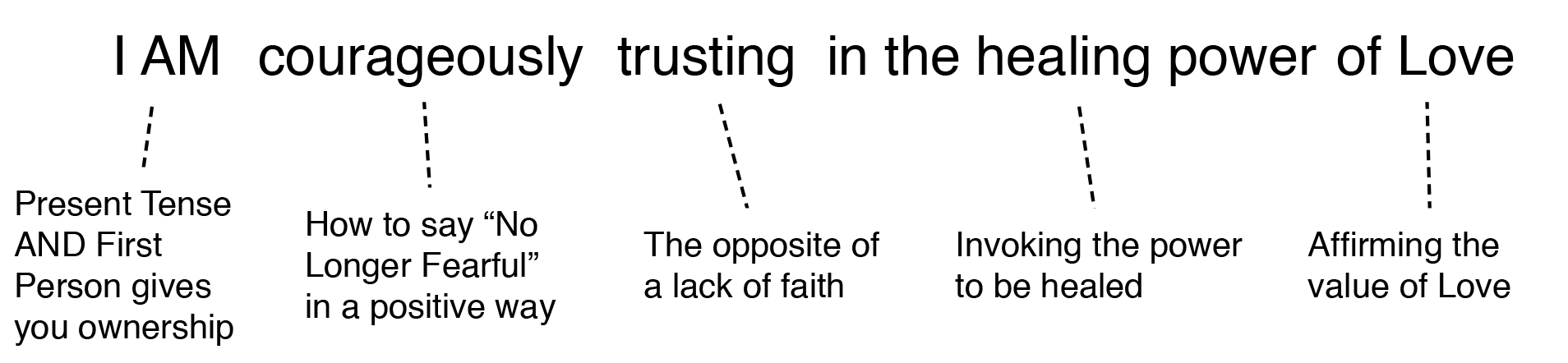
Ideal Scenes take this form one step further by placing the “I Am” statement in the middle of the page with phrases around a topic completing affirmations radiating out from this center. You then use the power of Repetition by saying a different affirmation several times a day. Print out your Ideal Scene and put it up by your bathroom mirror, front door, refrigerator door, under your TV remote. Then repeat an affirmation whenever you touch one of these objects.
My current Ideal Scene describing my spiritual journey is below.
I keep to (my) routine every day without variation. The repetition itself becomes the important thing; it’s a form of mesmerism. I mesmerize myself to reach a deeper state of mind.
Haruki Murakami


Projections
What is a projection and how do we know we’re experiencing one? Projections happen when we experience an out-of-balance emotional reaction to a person or situation, then blame that person for our reaction. Any time someone pushes our buttons, in positive or negative ways, we are set up to go into projection.

Outer experience is a reflection of inner reality.
What is a projection and how do we know we’re experiencing one? Projections happen when we experience an out-of-balance emotional reaction to a person or situation, then blame that person for our reaction. Any time someone pushes our buttons, in positive or negative ways, we are set up to go into projection.
Positive Projections happen when we put someone up on a pedestal. We see only their good and they can do no wrong in our eyes. When our heroes fall, they fall hard, and we can come to despise those who do not live up to our unrealistic expectations. It is important to remember we are projecting positive attributes that are inside ourselves onto another person. If we didn’t have those qualities inside ourselves, we literally couldn’t see them in others.
Negative Projections happen when we are projecting what we consider a negative attribute that is inside ourselves onto another person. Any time someone does something that causes a strong reaction inside us (anger, fear, sadness, worry) there is a projection present. When we say “This guy cut me off in traffic and he made me so mad!” what we are really saying is his action triggered us and we chose react in anger.
This can be the challenging part of projections for many people. It can feel so good to get mad at someone else and blame them for our reaction. We can feel superior in knowing they are wrong and we are right. But as long as we blame the other person, we give away our power. They can control our mood just by repeating that action. If we take responsibility for our responses though, we take the first step toward owning our own power and staying centered.
Taking responsibility of our own reactions doesn’t mean blaming ourselves. Rather, it points our energies toward the part we can change. With practice, we have the ability to control our own inner world, but vanishingly little influence over other people in the external world. This perspective allows us to stop trying to change other people. What a weight off our shoulders!
How to Work With Projections
1. Something happens in the physical world that triggers you. (My brother called me stupid.)
2. You have an emotional reaction. (I feel angry, hurt, sad, or afraid.)
3. You go into judgment. (He’s a jerk; only jerks talk that way.)
4. You now have two choices:
A. Continue to blame and make the other person wrong and enjoy being self-righteous.
If this is your choice, you will go back to step one and the pattern will continue.
B. Recognize you are running a projection and you have an opportunity for healing and growth.
5. If you choose “b,” look into the mirror the other person is holding up for you. (How do I do the
same thing to myself? In what way do I see myself as stupid? What judgments do I hold against myself?)
6. What does the mirror tell you? (My mirror is reflecting to me I am afraid of not being smart or
good enough. Do I deserve to be loved if I make a mistake?)
7. Accept this pattern without making yourself wrong for having it. (I take 100% responsibility for this
pattern, knowing it has nothing to do with my worth and value as a person.)
8. Move into compassionate self-forgiveness. (I forgive myself for judging my brother as a jerk. I
forgive myself for judging myself as being less than, not smart enough and not good enough.)
Projections are not for the faint of heart. Working with them really is an advanced technique because it requires you to own for yourself the very thing you think you despise in other people. Our opportunity is to feel the upset, then follow that line of energy back until we find the place inside that is asking for healing.
The power of owning a projection is to release yourself from old patterns that no longer serve you and to come to a place of compassion for yourself and others.
“If only it were all so simple! If only there were evil people somewhere committing evil deeds, and it were necessary only to separate them from the rest of us and destroy them. But the line dividing good and evil cuts through the heart of every human being. And who is willing to destroy a piece of his own heart?”

Win Every Argument
Being right feels wonderful. Life would be so sweet if every time we disagree with our partner they would bow to our superior intellect and admit they are wrong. Since that seldom seems to happen, we learn how to argue, debate, bully, cajole, guilt trip, whine, seduce, deceive, punish and reward the ones we love to get our way.

We argue to get our needs met, and our
needs will never be met by arguing.
-- The Author
Being right feels wonderful. Life would be so sweet if every time we disagree with our partner they would bow to our superior intellect and admit they are wrong. Since that seldom seems to happen, we learn how to argue, debate, bully, cajole, guilt trip, whine, seduce, deceive, punish and reward the ones we love to get our way. Difference of opinion is not necessarily a bad thing. Conflicts arise in every relationship and expressing our needs is healthy and necessary. Getting stuck in a pattern of arguing, though, can be hurtful and damaging to a relationship.
Arguments occur when the needs of one person are in conflict with the needs of another. For example, I think I have mentioned to you many times when you leave the cap off the toothpaste it gets all crusty and gross. You’ve told me an equal number of times you bought the toothpaste and will put the cap where you like. Who will win this conflict? If the cap goes on, I win and if the cap stays off, you win. If we choose a pattern of argument to settle this conflict, we could fall into using the following unproductive strategies.
The Debate Team Strategy is based on coming up with a devastating logical construct so clever it blows the other person out of the water. You win and your opponent loses. Logical arguments work quite well in courtrooms, debate teams or computer programs but are spectacularly unhelpful in nurturing a loving relationship.

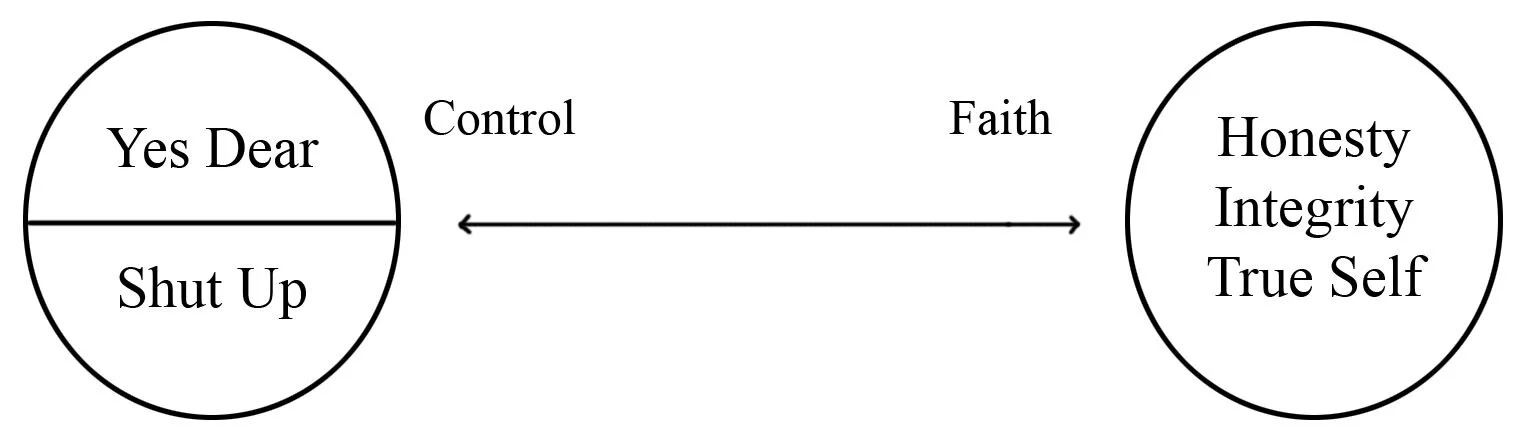
Yes Dear / Shut Up
The Yes Dear Strategy is used when debating with your partner doesn’t work, the next thing we try is to kill our partners with kindness. There is no way she can argue with me if I agree with everything she says. It might keep the peace; but it is a false peace. It is a passive way to control our partner.
The Shut Up Strategy When we can’t take being fake-nice anymore we try being a bully. We yell, scream, throw things and boss people around (or try to). This is an aggressive method of control.
Control / Faith
The Yes Dear and Shut Up strategies seem like they are on opposite ends of the spectrum, and they are on the Passive / Aggressive continuum. With both methods, however, we are trying to control the other person. From this perspective, they are two sides of the same controlling coin. It takes an act of faith in yourself and your partner to give up the need to be in control, stand in your integrity, and share your true Self. Many of us feel we have two choices in an argument; give in or stand our ground. It can be liberating to know that there is a third choice: compassion.
The Stone Wall Strategy When all else fails, we just stop saying or reacting to anything. We get upset, grit our teeth and bear it, and push it under the surface. This is also known as emotional cutoff and is the most dangerous of these strategies. If left unchecked it can be a most serious threat to the relationship. Total emotional silence kills relationships.
We win every argument by recognizing we are in old patterns of fear and anger, and stepping out of that pattern. In the past, the most important thing might have been to argue long and loudly until we “win.” How would things change if we recognize our most important goal is to lovingly connect? What will take us to this goal; blame and anger or love and compassion? Each disagreement is an opportunity to choose love over anger, leave blame behind and step into compassion. Here are some tools to do just that.
See the Pattern Arguing becomes especially destructive when it becomes a pattern. You will never step out of a pattern if you don’t see you are in one. Be present and check inside yourself. Is your heart rate and breathing increased? Is your speech loud and rapid? Do you have a closed body position? Do you feel angry or hurt? These are signs you have fallen into the argument pattern again and is the first skill you need to step out of this cycle.
Heart Centered Listening Instead of listening for logic flaws with your critical self, listen for the meaning of the words with your compassionate Self.
Keep on Topic In order to get more ammunition we will often dredge up a laundry list of every slight, insult, and mistake that has ever happened in the relationship. There’s time enough later for those past hurts. Stay in the moment. What’s present for you right now?
Both Win We are equal partners in this relationship. We are on the same team. If one wins, we both win; and if one of us loses, we both lose. Work on a solution together.
Right and Wrong (Hint: there is no healing in being right or wrong.) We can fall into a pattern of needing to be right at all costs. We can either be right, or we can be loving, but it’s impossible to be both.
I’m Upset Because Every argument begins this way, but as long as the conversation stays on this level, the argument never ends. Arguing is a mental sport and the smarter you are, the more likely you are to try to solve everything on the mental level. A loving resolution requires compassion, which comes from the heart, not the head. To be effective, we must move our energy from our head to our heart.
It’s Not about the Toothpaste It is almost always true that whatever the topic of your argument, it is not the real reason for the argument. You insist on leaving the cap off the toothpaste even though I’ve told you a thousand times it really bothers me. How could you upset me like this? Of course: it’s not about the toothpaste. The toothpaste is the trigger and we choose to go into a pattern of upset. The upset points to a hurt place inside we feel needs protecting. Not every argument will be about trivial things like toothpaste. Sometimes we will argue about huge, life-changing things. The same tools apply so practice on the small things.
Exit the Argument and Reconnect When an argument is done, it is done. Successful couples learn how to exit an argument. It’s important for us both to have our say and to work on a creative solution together. When the argument is over, reconnect with a smile, a loving touch, or tender look that says I’m still with you.
What does this move into compassion look like? In the argument described on the first page, the obvious issue is whether the cap is on the toothpaste or not. That seems trivial, but this is only the tip of the iceberg of what’s going on. The larger issues are: Do you value our beautiful home? Do you value my opinion? Do you still love and want to have a life with me? These questions are not trivial; they are deep and complicated. In fact, it is much easier for me to pick a fight about toothpaste rather than face these deeper issues.
These issues take faith, courage, and compassion and are the path to loving connection.
Out beyond ideas of wrongdoing and rightdoing there is a field. I’ll meet you there.
When the soul lies down in that grass the world is too full to talk about.
― Jalaluddin Mevlana Rumi - مولوی

Billy's New Office
After ten beautiful years in private practice at Kerbey Lane I'm making a BIG MOVE! (Ok, I'm moving three blocks away, but it's big to me.)
Hello Friends,
After ten beautiful years in private practice at Kerbey Lane I'm making a BIG MOVE! (Ok, I'm moving three blocks away, but it's big to me.)

Come see me at my new Franklin Square office:
3724 Jefferson
Suite 206
Austin, TX 78731
You can find a map here.
That's enough news for one email, but WAIT, there's more! I also have a new domain and a website to boot:
...created by the amazingly talented Katrina Repman. The whole site is wonderful; and I especially love the logo she created. When I first saw it, I had the urge to drink tea out of a mug with that logo; but maybe I should unpack all the cardboard boxes first.
Many thanks to my friends, family, colleagues and clients.
I know I wouldn't be here without you.
>billy